
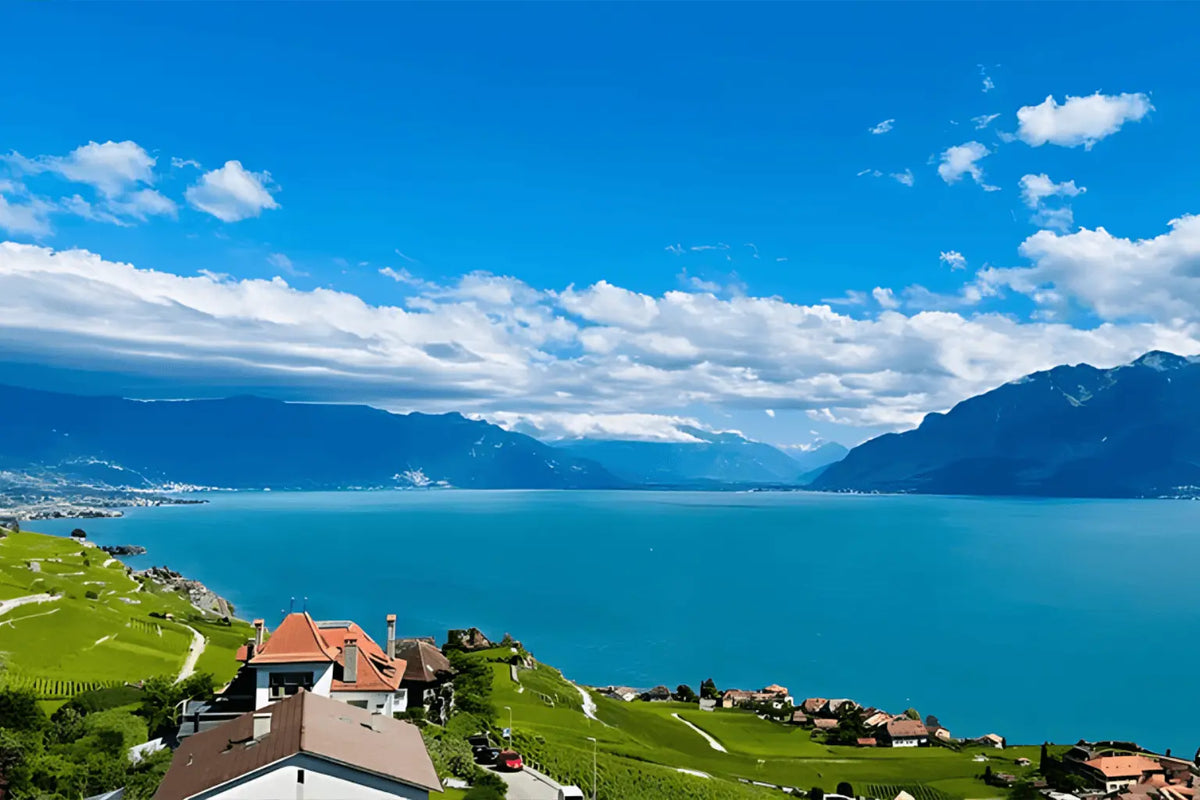
Switzerland has a worldwide reputation for the quality of its water. And on the whole, it is deserved: the latest federal report (2022 to 2024) confirms that Swiss drinking water is among the best in the world.¹ But “drinkable” does not mean “nothing in it”. Excess nitrates on the Swiss Plateau, pesticides detected in Lake Geneva, PFAS found in 46% of samples analysed in 2023.² Here is what the official data really reveal, and why filtering remains a sensible decision even in Switzerland.
The short answer: yes, but with important nuances.
Swiss tap water is monitored, treated and compliant with legal standards in the vast majority of cases. But standards change, some emerging substances are not yet systematically measured everywhere, and quality varies significantly between cantons and sources of supply, and depending on what lies upstream in the soil.
Key figures in Switzerland
What is really in Swiss water
Nitrates
Agricultural fertilisers washed into the groundwater
In Switzerland, drinking water must not exceed 40 mg/L of nitrates, and the groundwater used to produce it 25 mg/L. In intensive farming areas, the situation is a cause for concern: around one groundwater monitoring station in six exceeds 25 mg/L, and more than half in arable farming regions. More than 80% of stations on the Swiss Plateau record concentrations above 10 mg/L.¹
The most exposed cantons are Vaud, Fribourg, Bern and parts of Thurgau and Aargau, where intensive farming is concentrated. Excess nitrates are particularly problematic for infants under 6 months, as they interfere with the transport of oxygen in the blood.
Pesticides and metabolites
Residues from agricultural treatments and fungicides
In 2025, analyses in the cantons of Geneva and Vaud detected 1,2,4-triazole (a fungicide metabolite) at concentrations exceeding federal requirements in networks supplied by Lake Geneva.⁴ It is not the active molecule that is detected, but what it turns into after breaking down in the environment.
In response, the Federal Council opened a consultation in 2025 to tighten limit values for pesticides. Currently, only 19 substances are covered by ecotoxicological limit values, a fraction of what is actually used and detectable in water.⁴
PFAS: “forever chemicals”
Per- and polyfluoroalkyl substances
In 2023, the Association of Cantonal Chemists of Switzerland (ACCS) analysed 564 drinking water samples covering around 70% of the Swiss population. Result: 54% of samples contained no detectable PFAS, which is reassuring. But 46% contained measurable levels, and 0.9% already exceeded the European limit of 0.1 µg/L, which has applied in the European Union since January 2026 but is not yet binding in Switzerland.²
The most worrying point: 99% of samples contained trifluoroacetic acid (TFA), a little-known PFAS resulting from the breakdown of certain pesticides and refrigerants. Its health risks are currently being assessed by the European agency EFSA.²
Limescale (water hardness)
Dissolved calcium and magnesium
Limescale is not dangerous to health: it is even a source of calcium and magnesium. But very hard water (common in German-speaking Switzerland and on the Plateau, often above 25 to 30 °fH) leaves deposits on household appliances, pipes and coffee machines, and affects the taste. It is the main reason most Swiss households filter their water.
Residual chlorine
Disinfectant added to the distribution network
Added deliberately to maintain the microbiological quality of the water in the pipes. Harmless at the doses used, but responsible for the characteristic taste and smell that many people dislike. A simple activated carbon filter removes it effectively.
Quality by region: what the data show
General picture: variations remain significant from one municipality to another within the same canton
3 questions to assess your situation
If any of the answers is no, filtering is the sensible decision.
- Does your municipality publish recent analyses that include PFAS and pesticide metabolites, not just nitrates and hardness?
- Is your home far from any intensive farming area, airport, former landfill or industrial site that used firefighting foams?
- Is your household free of infants, pregnant women and immunocompromised people?
Swiss tap water is among the best in the world: the official data confirm it.¹ But “drinkable” does not mean “nothing in it”. Standards are set for the general healthy adult population, they change slowly, and substances such as PFAS or pesticide metabolites are not yet measured everywhere or subject to sufficiently strict limits. Filtering your water in Switzerland is not paranoia: it is an informed decision. The difference lies in choosing a system that really filters what is in your water, with published laboratory results.
Sources & references
- FSVO / FOEN: Swiss drinking water quality report 2022 to 2024 & nitrate data for the Swiss Plateau. blv.admin.ch · SWI Swissinfo
- Association of Cantonal Chemists of Switzerland (ACCS): national PFAS campaign on drinking water, 564 samples, October 2023. Press release (PDF)
- Fédération Romande des Consommateurs (FRC): municipalities’ transparency on water quality, 2023. frc.ch
- RTS / Federal Council: consultation on tightening pesticide limits in water, 2025. rts.ch
- Canton of Vaud: detection of 1,2,4-triazole in Lake Geneva water, 2025 analyses. vd.ch
- EFSA: scientific opinion on PFAS in food, tolerable weekly intake, 2020. efsa.europa.eu
- Eawag (Swiss Federal Institute of Aquatic Science and Technology): PFAS and groundwater resources. eawag.ch